Blog
Fireplaces and Feature Walls: Building a Focal Point for Upstate Winters
Winter in Upstate New York is long enough that the rooms you spend it in ought to earn their keep. From November through March, a family living room in Monroe County does most of the work of the house. It is where everyone ends up after dinner, where the holidays happen, and where you spend the dark stretch of the afternoon when it is already getting dim at four thirty.
A room like that wants a center. Something the furniture can face and the eye can land on, something that gives the space a reason to be arranged the way it is. Without one, a living room tends to orient itself around whatever the largest object happens to be, which is usually a television, and the result is a room that feels functional but never quite settled.
That is what a fireplace or a well-designed feature wall does. It gives a room its anchor. Here is how we think about building one.
Gas, Wood, and Electric
Each of these is the right answer for someone. A gas fireplace is the most practical for daily use, because it lights instantly, produces reliable heat, requires no hauling or cleanup, and can run on a switch or a remote. For a family that wants a fire on a Tuesday night in February without thinking about it, gas is usually where we land. Direct vent units can be placed on an exterior wall without a traditional chimney, which opens up locations that a wood fireplace could never occupy.
Wood is the real thing, and people who want wood generally know it. The sound, the smell, the heat quality, and the ritual of building a fire are not things gas reproduces. It demands a proper chimney or an insulated flue, storage for seasoned wood, and regular maintenance. If your home has an existing masonry fireplace that has fallen out of use, restoring it or fitting it with an efficient insert is often better than starting over somewhere else.
Electric has improved considerably and has a legitimate role. It needs no venting at all, which makes it possible almost anywhere, including interior walls and basements where running a flue would be impractical. It is the easiest to add during a remodel, and the flame effect on current units is far better than it used to be.
Adding One Where There Is Not One
Homeowners often assume that a house without a fireplace cannot have one, and that is rarely true. Direct vent gas units have made this dramatically more achievable, because they vent horizontally through an exterior wall rather than requiring a chimney rising through the roof.
What it does take is planning. There is framing to build for the unit and the surround, gas to run, electrical for the ignition and the blower, venting to route correctly, and clearances to combustibles that are not negotiable. It is a real project, but it is a normal one. The best time to do it is during other work, when walls are already open, which is why it comes up so often when we are already building an addition or reworking a living space.
The Surround Is the Design
The firebox is the mechanical part. The surround is what you actually look at, and it determines whether the fireplace reads as traditional, rustic, or contemporary. Stone gives weight and texture and is hard to beat in a great room, especially when it runs full height to the ceiling and lets the room's scale work for it. Natural stone and quality manufactured stone both have their place depending on the look and the structural situation.
Tile has become a favorite for good reason. Handmade zellige, slim vertical stacked tile, and large-format porcelain all do different things, and a tiled surround can feel clean and modern in a way stone does not. Brick, whether new, reclaimed, or painted, suits older homes and lends a room a lot of character with very little fuss. Plaster and limewash finishes have come back strongly and produce a soft, sculptural surround with no visible joints at all.
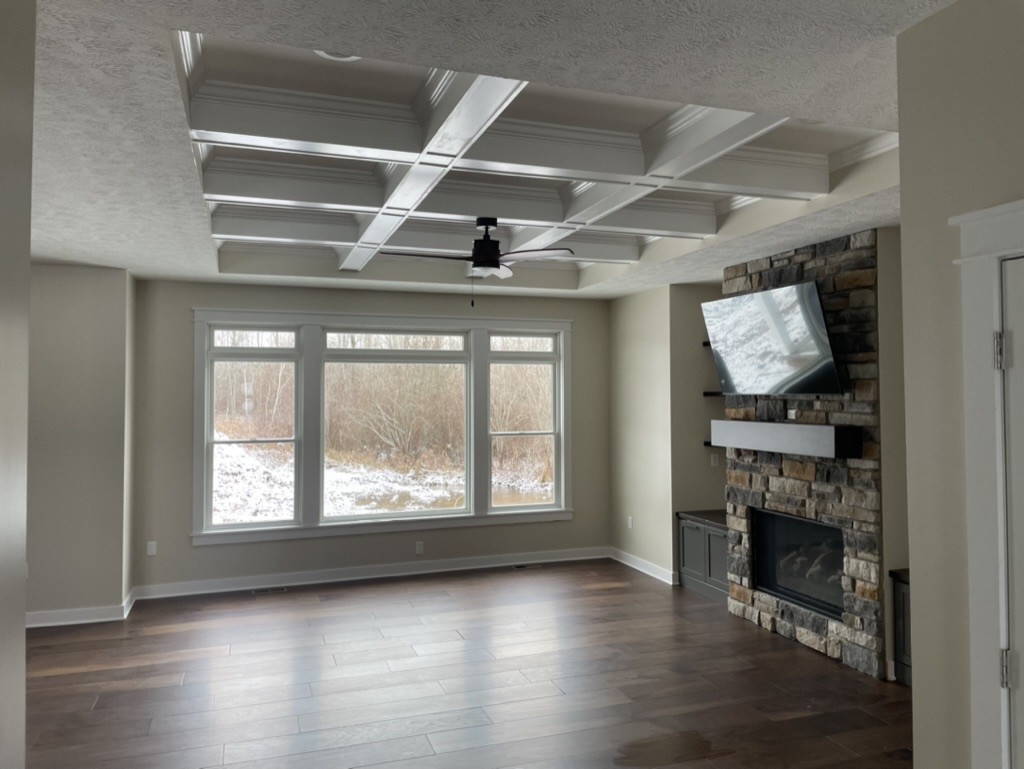
In a new build in Brockport we paired a stone fireplace with a coffered ceiling, and those two elements together are what give that great room its presence. The fireplace grounds the room and the ceiling closes it in, and neither would do as much alone.
Mantels and Hearths
The mantel is where personality concentrates. A rough-hewn timber, a reclaimed beam, a clean painted shelf, or a substantial stained piece with returns all send different signals. A live-edge or rustic beam adds warmth to a contemporary room and keeps stone from feeling austere. A simple painted mantel keeps a traditional room from feeling heavy.
Hearths deserve thought too. A raised hearth creates casual seating, which matters more than people expect when you are hosting. A flush hearth reads cleaner and modern and keeps the floor plane uninterrupted. With a wood-burning unit the hearth requirements are dictated by code and clearances, so the aesthetic decision and the safety requirement have to be reconciled from the beginning.
The Television Question
Everyone asks about it, so here is the honest answer. Mounting a television above a fireplace is extremely common and it is often the only practical wall in the room. The concerns are real but manageable. Viewing height can be too high for comfort if the mantel sits high, and heat rising off the firebox has to be accounted for.
Both are solvable at the design stage. Keeping the mantel at a reasonable height, choosing a unit with proper heat management, building a recessed niche so the screen sits back rather than protruding, and running conduit for cables inside the wall during framing all produce a result that works and looks deliberate. What does not work is deciding after the surround is finished, because then the cables are surface-mounted and the whole thing looks like an afterthought. This is a decision to make early, while the wall is open.
Feature Walls Without a Fire
Not every room needs a fireplace to have a focal point. A wall treatment can do the same job, and in bedrooms, dining rooms, and offices it is often the better move. Vertical shiplap or board and batten gives texture and a sense of craft. A full wall of paneling or picture frame molding brings architecture to a plain room. Stone or brick on a single wall adds material warmth. Even a deeply saturated paint color on one wall, paired with the right trim, can anchor a space.
The principle is the same as with a fireplace. Give the room one place that the eye goes to first, build it well, and let the rest of the room relax around it.
Let's Talk About Your Living Space
If your main living room has never felt quite right, there is a decent chance it is missing a center rather than missing furniture. Jason or Andrea Mallette will sit down with you, look at the room and how you use it, and talk through what could be built there, whether that is a fireplace, a surround on an existing one, or a wall treatment that does the same work.
Jason and Andrea Mallette have been building for Rochester area families for over thirty years, including great rooms, stone fireplaces, and the finish carpentry that makes them look right. Andrea helps with the material and finish decisions and Jason makes sure the framing, venting, and clearances behind them are done correctly.
Contact Mallette Quality Construction today to schedule your free consultation. We serve Rochester, Spencerport, and all of Monroe County, NY. Call us at (585) 755-8699.
‹ Back
Recent Posts
-
Open-Concept Conversions: What It Really Takes to Remove a Wall
November 18, 2026
-
Fireplaces and Feature Walls: Building a Focal Point for Upstate Winters
November 11, 2026
-
-
Powder Rooms and Guest Baths: Big Impact in the Smallest Room
October 30, 2026
-