
Blog
Mudroom and Entryway Additions: The Hardest-Working Square Footage You Can Add in Upstate NY
Anyone who has lived through more than one Rochester winter understands that the front door of an upstate home does not function the way the front door of a home in a milder climate does. It's the gateway between snowy boots and clean floors, between wet coats and a dry house, between sports gear and the rest of the family's belongings, between everything the day drags in and the home you actually want to live in. For most homes in our area, that gateway is woefully under-designed. A coat hook on the wall and a tray for shoes is doing the work of an entire transition zone, and it's losing every day.
That's exactly the gap a mudroom addition fills. Of all the additions we build for homeowners in Rochester, Spencerport, and Monroe County, the mudroom is consistently the one that gets the strongest "we should have done this years ago" reaction once the family has lived with it for a few weeks. It's small. It's not glamorous in the way a primary suite or a great room is. But pound for pound, it's one of the most life-improving spaces you can add to a home in upstate New York.
Thinking about a mudroom addition? Contact Mallette Quality Construction for a free consultation.
Why a Real Mudroom Matters So Much in Upstate New York
The reason a mudroom is so impactful in our climate is that we have all four seasons in their full intensity, and three of those four bring a lot of stuff into the house. Snow and salt and slush in the winter. Rain and mud in the spring. Lawn clippings and pollen in the summer. Wet leaves and boot prints in the fall. The only season that doesn't actively try to drag the outside in is the brief window when summer turns into early fall, and even then there's still gear coming and going.
Without a mudroom, all of that lands in the front entry, the foyer, the kitchen, or the living room. Every coat eventually ends up draped on a chair. Every wet boot tracks across whatever floor it touches. Every backpack and gym bag and grocery tote gets dropped in the first available spot. The house slowly becomes a battle against entropy that no amount of organization can win.
A real mudroom turns that battle into a process. There's a designated place for everything that comes through the door. Wet stays in the wet zone. Dirty stays in the dirty zone. Family members can drop, hang, and store everything they need to and then walk into a clean, dry home. The change in daily quality of life is genuinely dramatic, and it's why mudroom projects consistently get the strongest emotional response from the families we build them for.
The Elements That Make a Mudroom Actually Work
A mudroom that just looks like a mudroom isn't a mudroom. The functional elements are what separate a successful project from a Pinterest board. The features we consistently include in the mudroom projects we build for Rochester homeowners:
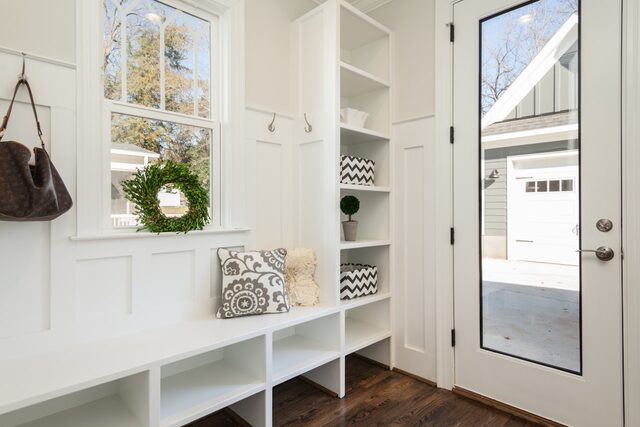
A bench with built-in storage. The bench is the anchor of the space. It gives you somewhere to sit while you take boots on and off, and the storage underneath is the right place for less-frequently-used footwear, sports equipment, or seasonal gear. The bench should be the right height for actual sitting, not just decorative.
Hooks at the right heights for everyone. Coat hooks installed at adult height only are missing half the family. Hooks at multiple heights, including ones the kids can actually reach, mean the kids can hang up their own coats and backpacks. That single design decision removes a daily nag from your life.
Cubbies or lockers for each family member. A dedicated spot per person, even if it's just a labeled cubby, transforms the chaos of "where's my stuff" into the order of "stuff goes here." For families with kids, this is one of the highest-impact features we install.
Closed cabinets or upper storage. Visible storage works for some things but creates visual clutter for others. Closed upper cabinets give you somewhere to put hats, gloves, scarves, and out-of-season items without having them stare at you every day.
Drop zones for keys, mail, and devices. The small surface area for the things that come out of pockets every time someone walks in. A small ledge with a drawer underneath, or a built-in console, takes the daily tide of small stuff and gives it a home.
Floor and wall surfaces that can take it. Mudroom floors and lower walls have to handle real abuse. Hard-surface flooring like tile or luxury vinyl, easily-cleaned wall surfaces, and thoughtful trim choices all matter. Carpet in a mudroom is a mistake. Drywall to the floor without protection is a mistake. The right materials make the difference between a mudroom that ages well and one that looks beat up after eighteen months.
Where to Add a Mudroom to Your Home
The right location for a mudroom depends entirely on how your family actually enters and exits the home. The front door might get the formal traffic, but the side door from the garage or driveway is usually where the real action happens. The most common configurations we build for Rochester homeowners:
An addition off the back or side door. This is the most common scenario. The home has a side or back entry that gets the daily use, and we add a mudroom right inside it. Sometimes that means bumping out, sometimes it means a small addition, sometimes it means converting and expanding an existing entry space.
A mudroom integrated with garage access. When the garage is the family's main entry into the home, the mudroom often sits between the garage and the kitchen or main living area. This is a powerful configuration because it intercepts everything before it gets into the rest of the house.
A combined mudroom and laundry. Combining the mudroom with a laundry room or a half-bath multiplies the value of the space. Wet coats can hang where they can drip safely. Dirty clothes go straight into the laundry. Pets can be wiped down before they get into the rest of the home.
A back-of-the-kitchen mudroom. Some older Rochester homes have an awkward back entry that comes directly into the kitchen. Reconfiguring that entry into a proper mudroom, sometimes with an addition and sometimes with a smart reuse of existing space, transforms one of the worst flow problems in the house.
Want help thinking through where a mudroom would fit on your home? Call us at (585) 755-8699.
The Hidden Value of a Well-Designed Mudroom
A mudroom is one of those additions where the value isn't always obvious until you've lived without one and then with one. The categories where the impact shows up:
Daily quality of life. This is the one homeowners feel first and most strongly. The home is cleaner. The chaos of comings and goings is contained. Mornings and evenings are calmer. The argument about whose coat is on the floor stops happening.
Protection of the rest of the home. The flooring, the walls, the rugs, and the furniture in the rest of the home all last longer when the mudroom is intercepting everything that would otherwise reach them. The maintenance reduction over years is real.
Resale appeal. Buyers in the Rochester market who tour homes consistently respond to mudrooms. They're not always at the top of the must-have list, but when buyers walk into a home that has one, especially a well-designed one, you can see the reaction. They get it.
The pride of the space itself. A beautiful mudroom is one of those small luxuries that makes you smile every time you walk through it. There's something deeply satisfying about a space that just works, every day, without any thought.
The Build Has to Match the Climate
Building a mudroom in Rochester is different from building one in a place that doesn't see real winter. The construction details that matter:
The transition from outside has to be airtight. Cold air, ice melt, and salt are constantly trying to get in. Proper weatherstripping, the right exterior door specification, and well-detailed thresholds make the difference between a mudroom that's comfortable and one that's drafty.
The flooring has to handle salt and water. Hard-surface flooring with proper drainage detailing where it makes sense, and finish materials selected for resistance to salt and moisture.
Heating matters. The mudroom should be tied into the home's heating system, and depending on the layout, in-floor radiant heat is one of the upgrades that delivers real daily satisfaction. Coming in from a cold winter morning and stepping onto a warm floor is one of those small luxuries that doesn't get old.
Lighting and ventilation deserve thought. Mudrooms tend to get used in low-light conditions, including before dawn and after dusk. Good layered lighting matters. So does ventilation, particularly when wet coats are hanging or pets are coming and going.
Let's Talk About Adding the Mudroom Your Family Needs
If your home has been losing the war with boots, coats, gear, and weather, we'd love to come walk through it with you and talk about what a real mudroom could do. The conversation always starts with understanding how your family actually moves through the home, where the friction is happening, and what kind of space would solve the problem for the way you really live.
Jason and Andrea Mallette have been building additions for Rochester families for over thirty years. We treat the mudroom with the same care and attention to detail as the largest projects we build, because we know how much daily life it's going to touch.
Contact Mallette Quality Construction today to schedule your free consultation. We serve Rochester, Spencerport, and all of Monroe County, NY. Call us at (585) 755-8699.
‹ Back
Recent Posts
-
-
-
Lakefront and Waterfront Home Builds: Designing for Upstate NY's Shorelines
September 29, 2026
-
Working With Your Insurance Company After Home Damage: A Homeowner's Guide
September 25, 2026
-
Boosting Curb Appeal: Exterior Upgrades That Transform a Rochester Home
September 20, 2026